




Sustainable Environmental Commitment
In order to implement E-BI sustainable environmental commitment, we adhere to the concept of responsible production strategy in the sustainable strategy blueprint, take green operation and low-carbon products as the environmental sustainable strategy policy, continuously promote climate change and energy management, water resources management, waste and recycling, and product green design and management, reduce environmental impact by improving the use of renewable raw materials and renewable energy, and take practical actions to complete the essence of E-BI sustainable issues.



·Establish a carbon emission collection system covering all supply chains
·Carbon inventory through CTI
Climate change and energy resource management
As climate change and energy management is one of the major issues and key risk projects for E-BI sustainable development, we are committed to the adjustment and reduction of greenhouse gas emissions, air quality, water resources and waste control and analysis. In terms of climate change mitigation, we set the SBT target as the carbon reduction path, continue to analyze and control internal energy use, and actively achieve the goal of reducing greenhouse gas emissions in violation of green design, energy management and energy creation, energy conservation, energy conversion products and solutions. In terms of climate change adaptation, we refer to the 2-degree scenario published by the International Energy Agency, and based on international research reports, industrial trends, internal and external investigations of enterprises, and corporate decisions and judgments, analyze and identify the short-, medium-and long-term risk projects that climate change may have on the operation of enterprises, and construct corresponding response capabilities for possible risk projects to reduce the possible impact of climate risks. In addition, policies have been set for all-round greenhouse gas emissions, including the use of renewable energy, energy-saving policies, green products, intelligent energy-saving technologies and other directions.
E-BI Climate-related Financial Disclosure Principles
Since 2018, the E-BI has supported TCFD in internal assessment and climate disclosure. It has exposed four core elements of climate-related financial information: governance, strategy, risk management, guidelines and objectives, established an information framework, identified major risks and opportunities that may cause operations, and proposed relevant response strategies. The following are described separately
Water resources management
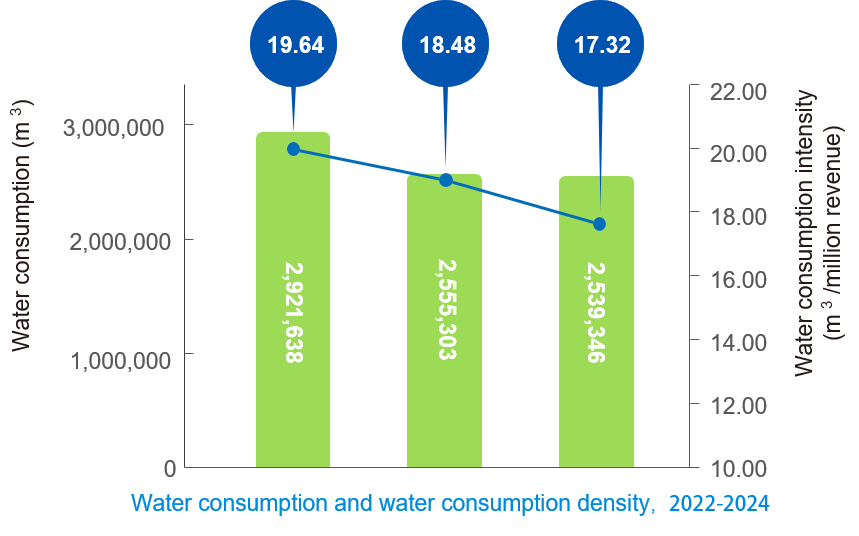
The E-BI establishes an environmental management system based on 1SO14001, manages water resources, and continues to promote water quality improvement and water conservation measures, including replacement of old pipelines, water switch point inspection and water inspection, and increase water recovery and reuse measures. Total water consumption in 2025 is 223335 m (down 0.62 percent from 2024) and water consumption intensity is 17.32 m3/million revenue (down 6.23 percent from 2024).
Wastewater management and resource utilization
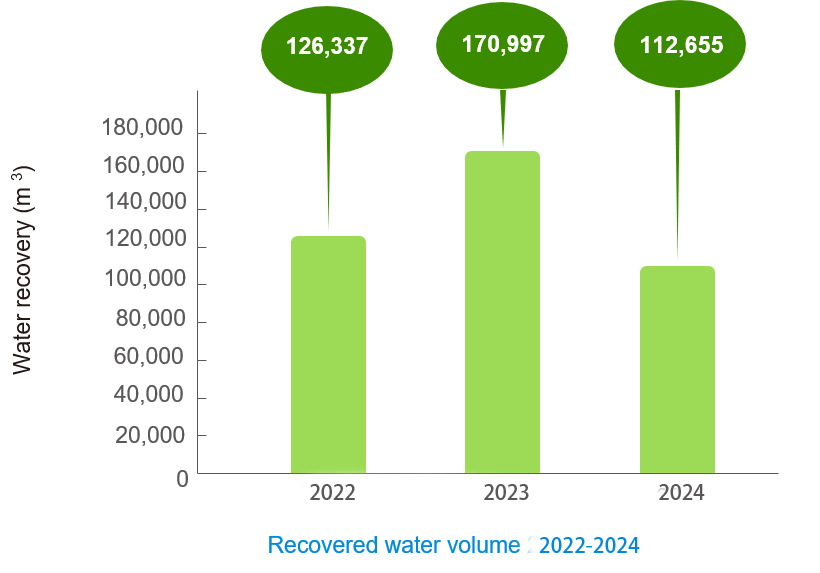
The water supply source of the E-BI's main operating locations is 100 per cent from municipal water (tap water), mainly domestic water for employees, and the resulting domestic sewage should be treated through appropriate sewage treatment facilities and should have no significant impact on the discharge water body.
Water resources management
E-BI follow the ISO 14001 standard to promote product green design and waste management measures, according to the production point to minimize the production of waste, increase the life cycle of each raw material, improve the recycling and reuse of sustainable resources, in order to achieve the waste reduction target.
E-BI the waste reuse plan carried out, the packaging materials, plastics, paper skins, cartons and alcohol are recycled, and the cartons are replaced with plastic boxes during loading to improve the reuse rate. In packaging, the utilization rate of paper skins is improved by reducing the amount of paper skins. In terms of waste disposal, E-BI, in addition to entrusting qualified disposers for incineration or reuse,
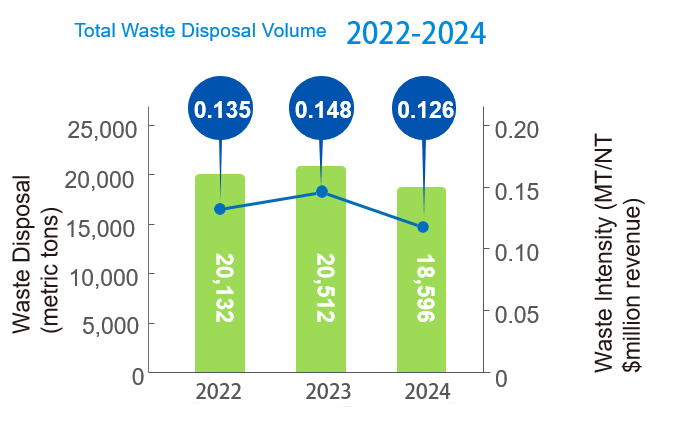
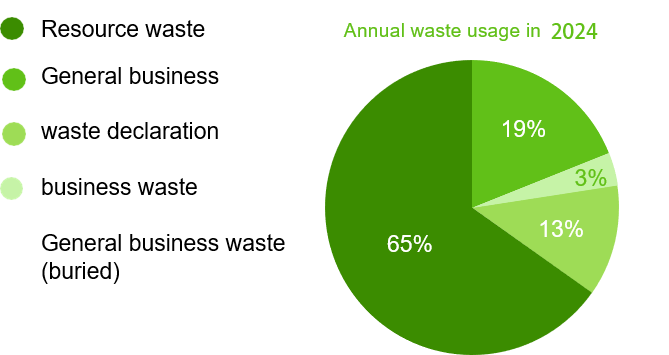
E-BI defines waste as general waste treatment methods, including burial treatment and incineration (non-compliant/energy recovery). The total amount of waste in 2025 is 185 tons, which is 1.916 tons (down 9.34) less than the total amount of waste in 2024, and 0.126 metric tons/million revenue in 2025, down 14.97 from 2024.
E-BI will continue to improve waste management and continue to move towards the target of 10% reduction in 2025.
Products Green Design and Management
- According to the company's CSR code of conduct, the E-BI takes life cycle thinking (Life Cycle of Thinking) as its foundation and integrates 3R(Reduce/Reuse/Recycle) principles into the green design of products to reduce the impact on the environment, effectively control environment-related substances, and develop environment-friendly products that are non-toxic, easy to assemble, easy to disassemble and extend the life of products.
- The E-BI is committed to building a sustainable value chain, working with suppliers to jointly develop low-carbon sustainable materials, and building an industrial circular economy through innovative research and development technologies.
- The British Carbon Trust circular economy theory: with design as the core, the product use stage, manufacturing stage and waste stage are connected in series, and finally a closed loop (Close Loop) is formed. According to the experience of industrial development, it has developed into seven executable and operable commercial modes of circular economy, including product sharing (Access), product service (Performance), repair and renovation (Re-condition), remanufacturing (Re-make), by-product and industrial symbiosis (Co-product Recovery), replacement of primary materials with recycled materials (Circular Souring) and resource regeneration and recovery (Resource Recovery).
- According to this model, the E-BI green design team conducts extensive investigation and evaluation, targeting materials with high added value and high carbon reduction potential, targeting specific materials and then conducting value engineering analysis and innovative technology research and development, and strengthening the research on industrial symbiosis resources through supplier investigation and technical cooperation in the value chain. With green design as the core concept, the E-BI finally focuses on the three major aspects of by-product and industrial symbiosis, the replacement of primary materials by recycled materials and resource regeneration and recovery, creating the foundation of industrial circular economy, and proposes a number of green solutions such as optimization technology of process resource utilization rate and the use of high proportion of recycling (Post-Consumer Recycling FCR) village materials.
Management of Environmental Related Substances
Since 2010, according to IECQ QC 080000 standard, referring to the latest international trends, regulations (IEC 62474 or beyond RoHS, REACH, California Act No. 65 and Montreal Protocol and other directives and specifications) and customer requirements, the E-BI has formulated the "Technical Standard for Hazardous Substances in E-BI Environmental Control" to control 100 percent of all products and materials. It is not regularly revised after reconciliation with the versions of various divisions,
The GSCM system combines material specifications, international regulations, international directives, customer specifications and supplier information, etc., and the supplier directly declares the results of product testing and analysis in the system, and uses the system to determine whether it conforms to the control content of the specification and directives, and then the E-BI conducts consolidation, analysis and inspection of its conformity. In addition, GSCM can not only take the initiative to provide customers with E-BI green product management related information, but also customer green product environmental requirements feedback to the management system.
Let's Start Something Great!
Call Us 24/7
503-644-2290
